Industrial products are no longer purely mechanical. A modern car contains tens of millions of lines of code. A medical device relies on safety-critical software. This evolution is transforming the way companies develop their products. Product teams and software teams must now collaborate from the earliest stages of a project.
For many years, product-related and software-related activities were managed in separate environments. On one side, PLM (Product Lifecycle Management). On the other, ALM (Application Lifecycle Management or Software Lifecycle Management). As software becomes an essential component of modern products, this separation is reaching its limits.
It is in this context that Dassault Systèmes has integrated Tuleap into the CATIA portfolio to strengthen the connection between ALM and PLM.

What is CATIA?
Developed by Dassault Systèmes, CATIA is one of the most widely used engineering platforms in the industrial sector. For more than forty years, CATIA has helped manufacturers design complex products across the world’s most demanding industries.
Initially recognized for its advanced 3D Computer-Aided Design (CAD) capabilities, CATIA has gradually evolved to address the challenges of modern systems engineering.
A key component of the 3DEXPERIENCE platform
CATIA is part of Dassault Systèmes 3DEXPERIENCE platform, which brings together all stakeholders involved in product development.
Designers, systems engineers, simulation experts, and validation managers can work from a shared source of truth. Data remains consistent throughout the project, making collaboration across disciplines easier.
This approach helps companies better manage the complexity of industrial programs while reducing the risks associated with information silos.
Why are manufacturers bringing ALM and PLM together?
Modern products now combine hardware, electronics, and software. This convergence creates new challenges. Companies must coordinate more teams, manage increasing amounts of data, and maintain a high level of traceability.
To achieve this, they are bringing product development and software development activities closer together.
Software is becoming a strategic asset
Software plays an increasingly important role in product value. In the automotive industry, it powers advanced driver assistance features. In healthcare, it supports the operation of safety-critical medical devices. In aerospace, it contributes to the safety and performance of embedded systems.
This evolution is fundamentally changing development practices. Software teams must collaborate with product teams from the earliest stages of a project.
Silos slow down projects
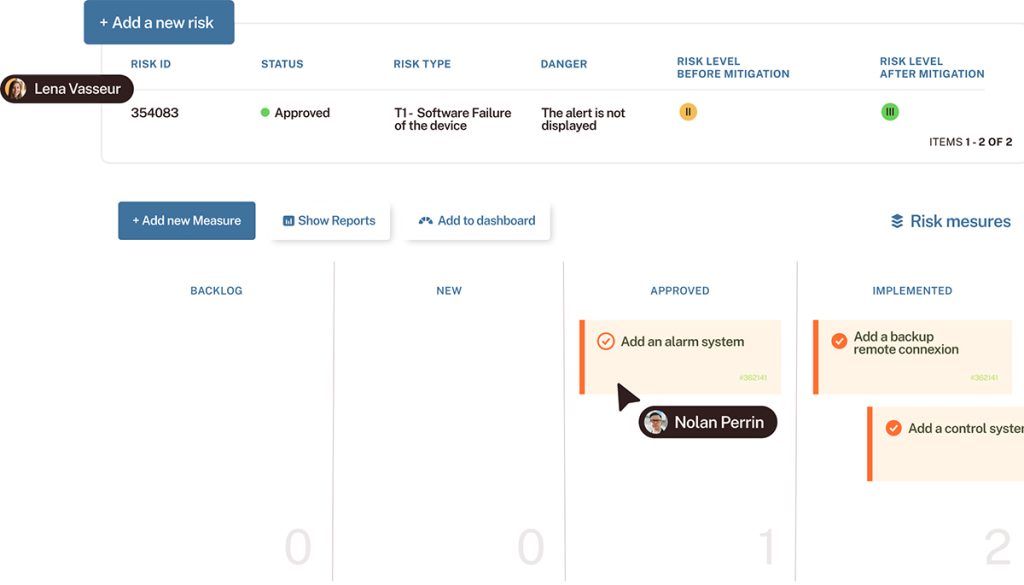
In many organizations, requirements, design, software development, and testing are managed in separate tools. Each team has its own view of the project. Information is often exchanged through exports, documents, or manual synchronization.
As a result, information flows less efficiently, impact analysis becomes more difficult, and the risk of errors increases whenever changes occur. This is precisely why CATIA adopted Tuleap: a comprehensive ALM platform capable of centralizing the entire software lifecycle while strengthening collaboration between teams.
Looking to centralize your project lifecycle management within a single platform
Requirements traceability is becoming a major challenge
Complex products are subject to increasingly demanding technical and regulatory requirements. Companies must demonstrate that every requirement has been properly addressed, implemented, tested, and validated.
Effective requirements management is the first step toward ensuring end-to-end traceability throughout the development lifecycle.
Discover how Tuleap helps teams centralize, structure, and track their requirements.
Why is the integration of Tuleap into the CATIA portfolio strategic?
The integration of Tuleap reflects a fundamental market shift: the convergence of product engineering and software engineering. Manufacturers are seeking greater continuity between the disciplines involved in developing complex systems.
Adding ALM capabilities to the CATIA portfolio
CATIA is recognized for its design, modeling, and systems engineering capabilities.
With Tuleap, the portfolio now includes a dedicated ALM solution for software lifecycle management.
Teams can manage requirements, plan development activities, track testing, and maintain end-to-end traceabilitythroughout the project.
This complementary approach addresses the needs of organizations developing systems where software and hardware are closely interconnected.
An ALM solution for software lifecycle management
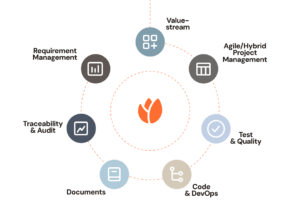
Tuleap expands the CATIA portfolio with a dedicated ALM solution for Software Lifecycle Management.
The platform centralizes:
All of that, within a single environment.
This gives teams greater visibility into their projects while maintaining traceability throughout the entire development lifecycle.
Connecting product and software teams
Developing a complex system requires expertise from multiple disciplines.
Systems engineering teams define requirements. Product teams design system architectures. Software teams develop functionality. Quality assurance and validation teams verify overall compliance.
To work efficiently, these stakeholders need to share a common view of the project and access the same information at the right time.
Strengthening digital continuity
A decision made during the requirements definition phase can have consequences for:
- Product design
- Software development
- Validation activities several months later
By bringing ALM and PLM closer together, companies gain greater visibility into these dependencies and can more easily track project evolution.
FAQ
Why integrate an ALM solution with CATIA?
An ALM solution such as Tuleap complements CATIA by adding requirements management, software development, testing, and traceability capabilities. Product and software teams can therefore work within a more consistent development environment.
What are the benefits of requirements traceability?
Requirements traceability connects requirements with design, development, testing, and validation activities. It simplifies impact analysis and improves project tracking.
How does this integration simplify change management?
When a requirement changes, teams can quickly identify the affected elements. This allows them to assess impacts more efficiently and make decisions faster.