Agile project management: methods and tools
Traditional project management in 3 methods and tools
Traditional or classic project management is based on a strict organization of work and a sequential way of operating, with no feedback loops, structured around several consecutive phases:
- once the project specifications have been defined with the customer, the Project Manager is responsible for ensuring that every task planned at each stage of the process is completed in line with predefined objectives,
- before being able to move on to the next phase,
- until the project is completed.
This methodical organization is designed to shield the project from risks by strictly following the plan defined upfront. However, for a method that leaves no room for change, the major risk is to deliver a product that ultimately no longer matches the customer’s expectations, as their needs may evolve along the way. Indeed, with a traditional method, any change would have heavy consequences, especially in terms of costs, since it would require reviewing all the project phases and restarting the process wherever modifications are needed. Traditional project management remains, nonetheless, an essential approach in certain types of organizations and for large-scale projects. Below are the three most widespread traditional methods.
1. Waterfall
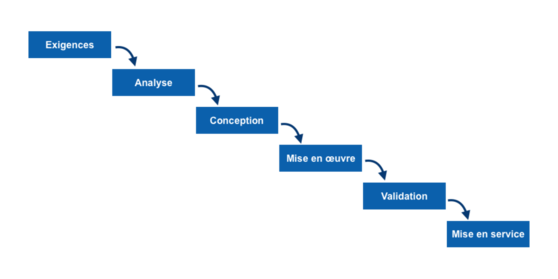
Among traditional approaches, the waterfall method is the one most frequently used to simplify project management with a strict, sequential process. Just like a waterfall, this method is based on the succession of predefined stages, where the completion of each phase leads to the next one, without the possibility of going back.
The waterfall model is essentially based on 6 key steps:
- Analysis of customer needs (Requirement)
- Design of deliverables (Design)
- Definition of budgets and deadlines (Planning)
- Start of implementation (Implementation)
- Validation and fixing (Verification)
- Maintenance of deliverables over time (Maintenance)
The main advantage of this model is that it provides a clear view of the schedule from the outset, which teams commit to following rigorously in order to successfully deliver the project. However, this way of working has significant drawbacks, particularly in terms of flexibility.
2. V-Model
The V-Model can be considered an extension and improvement of the waterfall model. The letter “V” comes from the graphical representation of this model, which links each development step to a corresponding validation phase.

This model is not suitable for every type of company because of its lack of flexibility and adaptability. However, it can be useful when the expected product specifications are clear, fixed, and must comply with strict quality standards. Ultimately, the V-Model is a rigid project management model whose main objective is to guarantee that the deliverables conform to customer requirements and relevant standards. A Gantt chart is often used alongside this method to get an overview of the project, even though it does not really provide a real-time view of progress, due to its rigidity.
Side note: to go further on this topic, in another article we talk about the Agile Gantt chart, which helps you more easily share a global vision of your project over time and as changes occur along the way. See for yourself how to use a Gantt chart for agile project management.
3. The PERT method
The PERT method (in French TEEP, Technique d’Évaluation et d’Examination des Programmes) is a graphical representation used to define the ordering of the phases of a project.
It is a visual organization tool that takes the form of a network with a clearly defined start and end. This network highlights the sequence of the project’s different stages as well as the tasks to be handled with more or less priority, depending on the deadlines to be met.
This is a classic method used to structure the development process of a project by coordinating the sequence of tasks. It provides clear guidelines for executing every operation, while also making it possible to define in advance the allocation of resources (including human and financial), roles, and the estimated duration of the process.

Agile project management methods: 7 common approaches and their tools
Today, with constant technological developments, traditional methods are being called into question because of their rigidity and heavy execution. The agile method therefore appears as the optimal solution for more efficient and secure project management. But don’t be mistaken: agile methodologies do not mean “no rules”!
The revolution of agile methods is essentially based on an approach that puts customer satisfaction and their needs at the heart of the process, rather than contractual terms. Although there are many agile methods that can be applied depending on the specificities and context of the company – even for managing agile projects remotely – they all revolve around the following key pillars:
- Breaking the project down into short cycles (iterations)
- Prioritizing tasks to avoid unnecessary work
- Focusing on creating real added value for the customer
- Seeking feedback and validating deliverables continuously
- Adapting to change, even late in the process
- Creating a truly collaborative spirit between all stakeholders
Want to learn more about these different methods, their characteristics, and how they work? Here is a selection of the most popular agile approaches.
1. Scrum
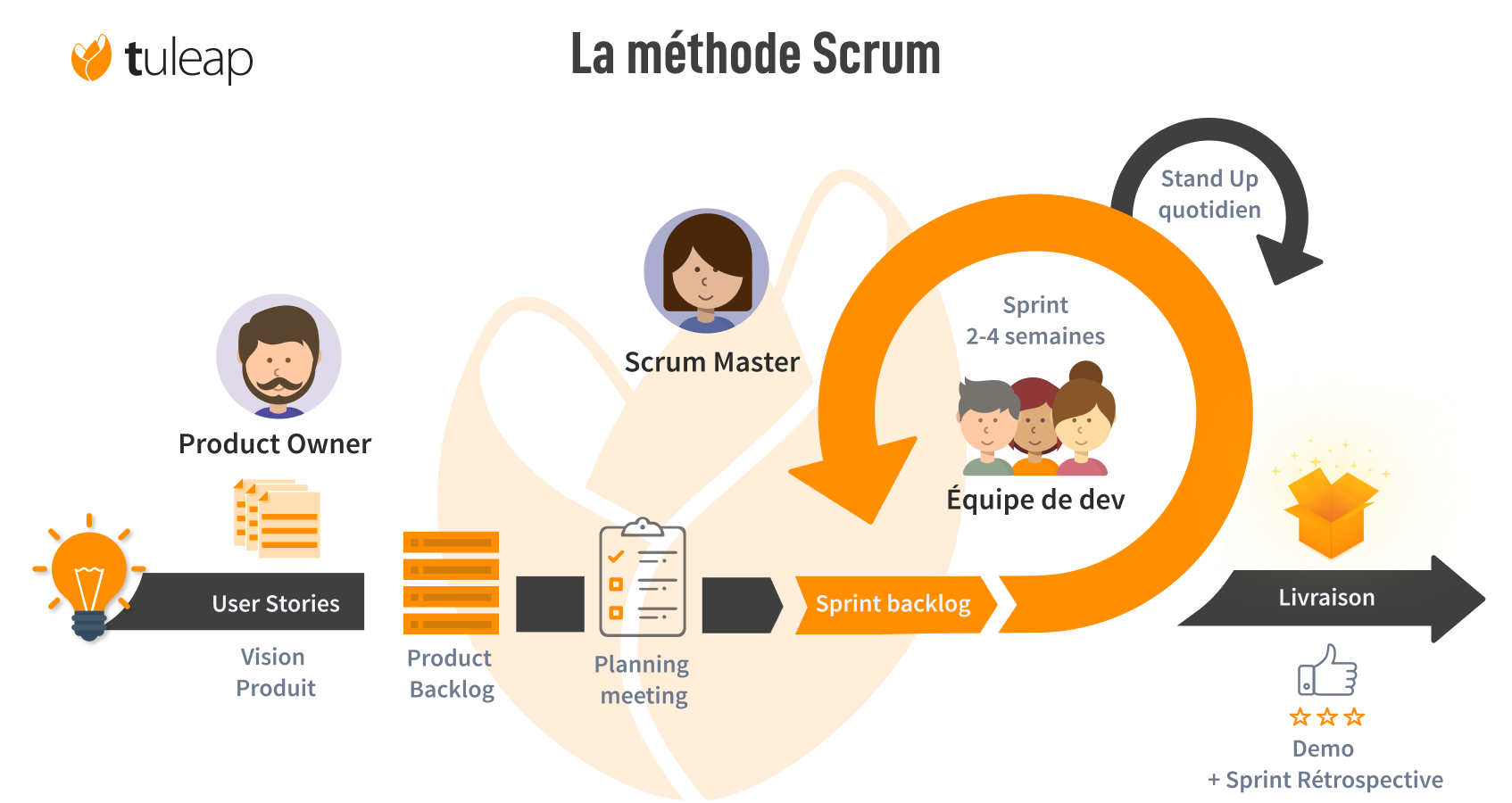
The Scrum agile method is certainly one of the most widely used methods in agile companies. Its basic principle: managing a project in an iterative way by running regular cycles (called sprints) lasting from one to four weeks. Throughout the development process, communication between team members is essential to success. Another cornerstone of Scrum is continuous improvement, not only to ensure higher productivity and better product quality, but also to maintain – and even encourage – stronger collaboration within the team.
Watch out for common misconceptions: is Agile project management the same thing as Scrum?
2. Kanban
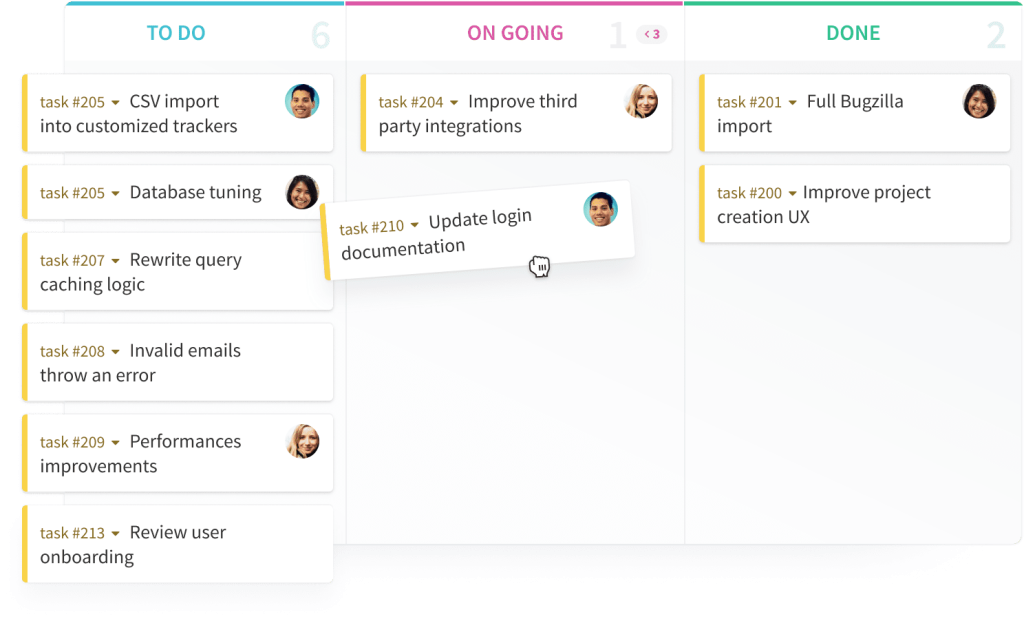
Kanban is both a method and a tool that is very popular in the agile world, as it provides a much clearer visual representation of a project’s progress. The ultimate goal of Kanban is to optimize flow management by progressively moving each task forward on the board, one column at a time. At the same time, this agile method fosters increased coordination and collaboration within teams, who benefit from clear, centralized visual information and real-time updates on project progress.
Kanban can be used alongside other agile methods such as Scrum (in which case we talk about Scrumban). The Kanban approach involves creating a dashboard divided into several columns, where you “stick” post-its representing tasks.
Each column corresponds to a stage in the project’s development and will be customized depending on the specificities of the company and team. Common columns in almost every project include: To Do, Work In Progress, and Done.
3. Scaled Agile Framework (SAFe®)

When it comes to agility at organizational scale, SAFe – Scaled Agile Framework is one of the most widely used scaling methods. It’s a framework applied across multiple teams to align them with the company’s overall strategy. The basic principle of SAFe is to break work down, structure it, and schedule it across teams while ensuring that each of them stays aligned with the final objective. By adopting this framework, the gradual implementation of greater flexibility and cross-functional collaboration enables increasingly effective project delivery… increasingly agile at scale.
In addition, there is a fairly technical SAFe glossary that helps bring consistency and make collaboration smoother between all stakeholders in the same product development initiative. This management framework is more appropriate for teams of at least 50 people, unlike other agile methods such as eXtreme Programming (explained just below).
4. EXtreme Programming (XP)
Another agile method that is very popular in project management today is eXtreme Programming, or XP. This method, which is compatible with all types of projects and organizations, has the particularity of pushing agile development principles to the extreme: customer needs at the heart of priorities, an iterative development process, and continuous improvement and integration. In short, the eXtreme Programming methodology goes straight to the point: by mastering task execution, pace of work, and relationships between individuals, this method aims to rapidly deliver the version of the product expected by the customer.
eXtreme Programming is based on 5 fundamental pillars:
- Communication: this is a key value for the success of any project. Communication must be encouraged and maintained between all the stakeholders involved in the development project, meaning both team members and customer(s).
- Simplicity: the team in charge of the project chooses the simplest way to achieve exactly the desired result, nothing more. This also makes future integrations and evolutions of the same product easier.
- Feedback: regular, fast feedback between the team and the customer is essential at every level of the project, so that any comments or change requests can be handled immediately.
- Courage: this value is essential to deal with potential changes. It enables the team to react quickly, consider alternatives, run tests, and reorganize certain aspects of the project while it is still in development.
- Respect: last but not least, mutual respect between management, team members, and customer(s) is crucial for the success of any project, especially in this kind of context where the quality of the delivered product strongly depends on the quality of the relationship built.
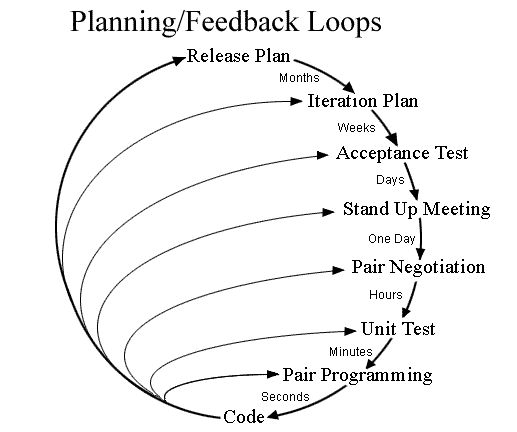
These founding values are the basis for all the more advanced agile practices that are specific to XP. More precisely, there are 13 interdependent practices according to which project management is built around a series of short, fast development iterations, driven by constant involvement and collaboration between the team and the customer. Here are just a few of them: on-site customer, continuous integration, small releases, sustainable pace, unit and functional tests, refactoring, coding standards, collective code ownership, pair programming… the very foundations of Agility!
5. Rational Unified Process (RUP)
Rational Unified Process is an agile framework that helps define the milestones of a project in order to then shape all the stages and assign the associated tasks. The goal is to optimize the overall management of the software development lifecycle and the delivery of the expected product, so that it meets users’ specific needs while respecting the initially planned deadlines and budgets.
The RUP method is essentially built around 4 main phases (or cycles):
- Inception: the starting point based on risk assessment, architecture, and project planning, broken down into several activities.
- Elaboration: understanding the customer’s needs and validating product specifications before starting development.
- Construction: the fully operational phase of software production and product testing.
- Transition: the final cycle, including the last system and user tests, any remaining fixes, and finally the delivery of the software product.
Beyond improving product quality, this method also helps increase the quality of work for teams by encouraging the participation of all stakeholders. One of the major strengths of RUP is its flexibility: development is seen as an iterative and incremental process, meaning changes can be integrated continuously. This responsiveness not only helps resolve technical issues, but also allows the product to be better adapted to real customer needs, thereby reducing the risk of “nasty surprises” at the end of the process.
6. Lean
Lean Management is a project management method created in the 1970s by Toyota and introduced for the first time in its factories in Japan. At the heart of this approach is the fight against waste in terms of resources, money, and time, in order to adopt a continuous improvement mindset so that work quality can steadily improve. To achieve this, the Lean method also aims to improve the working environment and conditions for all teams, which ultimately increases productivity. According to Lean philosophy, there are 7 main sources of waste that frequently occur in a company during any development and/or production process: overproduction, unused stock, waiting times, defects, activities related to transport and maintenance, and unnecessary operations and movements.

To improve project management and organizational profitability, the Lean method is a pragmatic solution built around regularly measuring the results obtained against defined objectives. This monitoring is carried out at every stage of the development process, using precise indicators defined according to the project’s characteristics and the company’s needs (e.g. number of features delivered, quantitative cost reduction, etc.).
Like any agile method, this way of managing projects is based on an iterative and incremental development process, in this case governed by 7 fundamental principles:
- Eliminate waste: this involves seeking to reduce costs in every possible way: unnecessary movements, unused stock, non-essential extra features, non-priority operations. In short, any action that does not add value to the final product – and risks slowing down development – must be eliminated.
- Create knowledge: optimize skills, encourage knowledge sharing, and plan training so that teams have all the necessary know-how to work efficiently.
- Defer commitment: the goal is to limit risks and maintain maximum flexibility throughout development, continually improving work quality and only committing to realistic delivery capabilities.
- Deliver fast: an iterative process based on frequent deliveries allows the company to validate each deliverable step by step and ensure it still matches customer needs and expectations. At the same time, the customer has a global view of project progress and is encouraged to take part.
- Empower the team: it is important to rely on collective intelligence and encourage everyone’s participation in the development process and, more broadly, in company life. Maintaining a positive climate of trust and respect plays a key role in building a high-performing agile team and improving overall performance.
- Build quality in: to ensure that the final product has real added value, quality assurance must be the common thread throughout the development process, from design through to presenting the deliverable to the customer.
- See the whole: even though the process is made up of several consecutive iterations, it is essential to maintain a global vision of the project to ensure alignment with the final objective. This overarching view also helps avoid risks such as additional costs or longer delivery times.
7. Feature Driven Development (FDD)
The FDD method (Feature Driven Development) is another agile solution for project delivery, often used within large organizations. It is mainly based on risk management and focuses on designing and developing software features quickly, in close collaboration with the customer, who is asked to validate and provide feedback throughout the project.
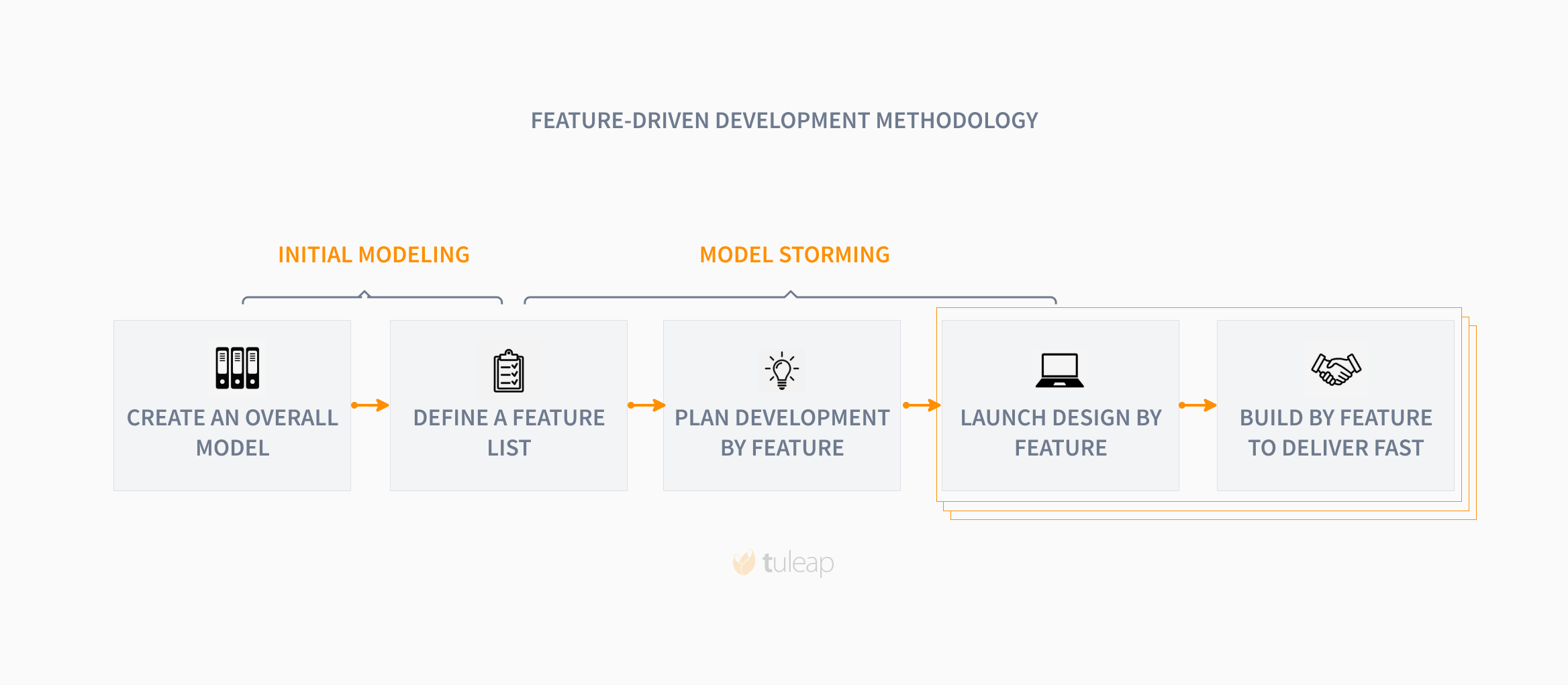
This method is based on each development process (or iteration) being structured into 5 consecutive steps:
- Creating a product model and technical documents, generally in the form of an organization chart, used to define the scope of actions to be carried out.
- Drawing up a list of all the features to be developed.
- Assigning features, based on their common characteristics, to specific developers who will be responsible for them.
- Creating a dedicated model for each feature to highlight its particularities.
- Launching the actual development process for product delivery.
The FDD approach ensures better communication throughout development, both within the team and with the customer, and emphasizes the importance of providing clear, accurate information on the process status – which strongly contributes to developers’ efficiency. In practice, this increased visibility on project progress also makes it possible to deliver more frequent increments, whose quality and functionality are tested and validated directly by the customer.
Although it meets all the criteria and values of agility, the FDD method is sometimes seen as sitting on the edge of agile best practices, because it assigns six specific technical roles depending on the project phase.
That said, assigning roles does not automatically mean “non-agile”! But it is true that the agile world has evolved a lot and has increasingly moved away from this approach in favor of shared responsibility among all stakeholders – which is more apparent in the other agile methodologies described above.
Agile vs traditional method: which one should I choose for my project?
Now that we have reviewed the available options in the world of project management, it’s time to take action and choose the most suitable method to successfully deliver all your projects!
Keep your current processes and use traditional methods…
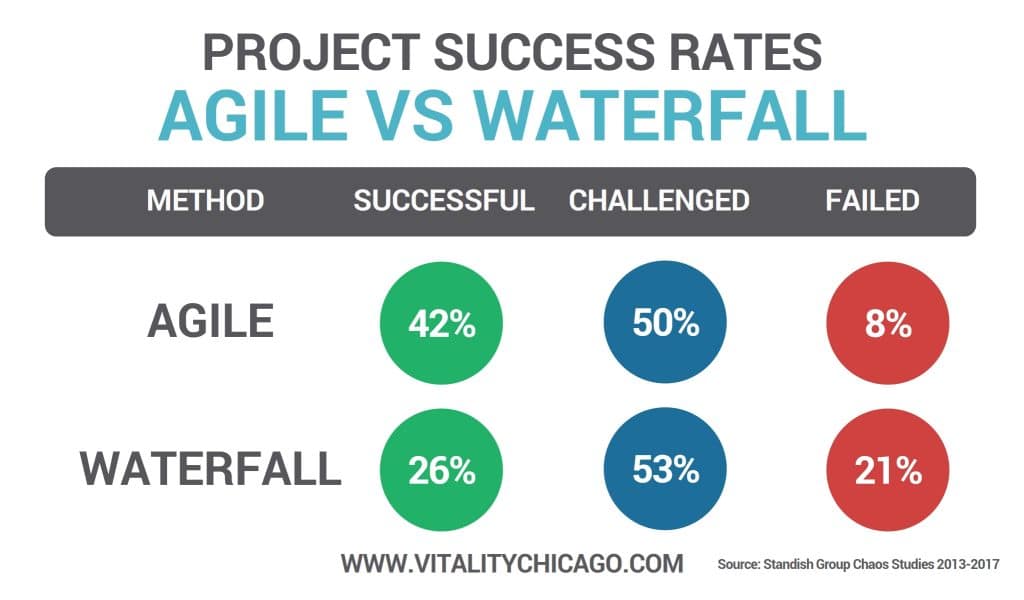
Companies that have, or are inclined to adopt, a traditional approach can still benefit from certain functional advantages: no risk of tasks overlapping, a clear view from the start of the resources to mobilize, the budget to plan, and the expected deadlines. A classic approach can therefore be useful when a company must follow strict protocols and sequential processes due to the requirements of its industry. However, the weaknesses of traditional methods – particularly the lack of collaboration and flexibility – will quickly start to show. Strictly planning the project from day one is not a guarantee of success… quite the opposite! It’s a proven fact that the vast majority of projects using this approach end up failing.
…or evolve and start your agile journey?
Agile methods bring significantly more flexibility, adaptability, and support for change. Change is no longer seen as a risk but rather as an opportunity to better steer the project and deliver an even higher-quality product to the end customer. In addition, agile approaches have the major advantage of being applicable not only to all types of companies and contexts, but also to a wide variety of job profiles. Choosing agility is not an obligation, but it is a transformation that any company wishing to improve its internal organization, communication, and collaboration should consider if it wants to boost its overall performance over the long term. Given that a company’s environment is never stable in the long run and changes regularly disrupt this balance, it becomes even more important to develop reaction capabilities – an agile mindset!
Beware of common misconceptions! Once again, agile methods are not just compatible with the IT department, developers, or very small teams and organizations. So, Agile or Not Agile, that’s the question: whatever your final verdict, it’s always good to know that there are open source collaborative project management tools that adapt perfectly to your working environment, whatever your current way of operating. And since we know very well that introducing a new tool into a company is no easy task, we share in another article 5 tips to facilitate the adoption of an agile tool to help you make your project a success.