Why implementing Tuleap to achieve industry-standards compliance?
A tool like Tuleap can be a true ally when developing medical software products, as it helps:
- Centralize and secure all software projects’ data in one place, hence relying on a unique digital reference
- Have a large set of adapted tools for the integrated management of your medical device software’s development and maintenance processes (requirement management, risk management, release planning, version management, tests management, bug fixing, integrations…)
- Standardize processes thanks to templates (workspaces) that can be easily customizable accordingly to the specificities of both the organization and the industry
- Automate workflows to increase productivity and avoid risk occurrence in the artifacts and documents management process
- Ensure automatic, end-to-end traceability throughout the whole software lifecycle via a thorough modification history
- Follow activities and projects progress in real time via customizable (agile) dashboards that help prepare and pass compliance audits faster and more efficiently even remotely
What is important to underline is that the tool comes to support, and not substitute, the organization because they both are necessary and actually complementary. The main point is to have a tool providing all the necessary features for software development management and maintenance, that is to say a good application lifecycle management tool (ALM).
Want to keep your processes under control and align with IEC 62304?
The common medical device software lifecycle and how Tuleap helps at every stage
1. Use case definition
It is extremely important to have a clear insight into the software project’s scope and direction from the very beginning in order to ensure its smooth development and delivery, all the more within a highly-standardized industry such as the medical device. This is why it is primordial to understand customers’ needs.
Tuleap provides a workspace to collect customers’ expectations and needs, also called user stories, to subsequently ease the organization of all the technical tasks for the development of the desired features.
In addition to it, Tuleap provides teams with a secured document management workspace to store all their project information as well as to collaborate on documents.

2. Analysis and risk management
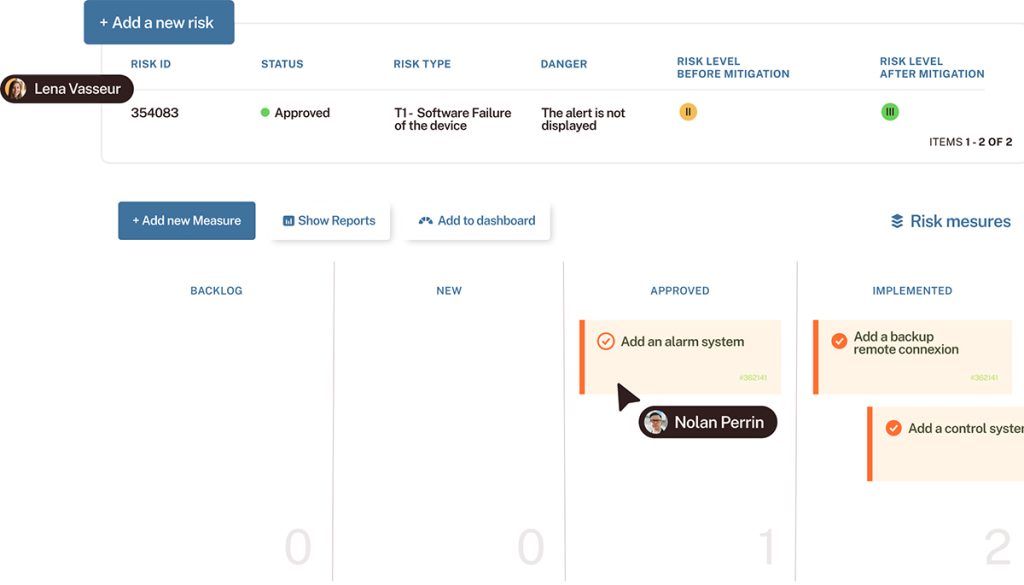
Tuleap makes it possible to go further in risk management thanks to a notification system and mitigating risk management that can be defined accordingly to the product specifications and requirements. It’s even possible to add as many mitigating measures as you wish. All these elements can be easily set up via the central part of the Tuleap workspace interface, displaying a specific dashboard for Risk Management.
Now, how to integrate a new feature, such as a customer change request, once the development process got started? You can add it directly from the dashboard mentioned above, which is generally a Kanban board, and easily configure it.
Lastly, Tuleap allows linking any items among them via a parent-child hierarchy and then putting them into a customizable tracking system, ensuring seamless end-to-end traceability throughout the whole software project.

3. Planning
Once features are defined, teams can move on to the release planning phase, prioritizing work based on the requirements to be met. With Tuleap, the process corresponds to creating and organizing tasks (and even sub-tasks) via agile dashboards. This enables teams to optimize their productivity thanks to increased visibility of the real-time progress of the development project. With the Agile Roadmap plugin, clearly show all the planned and/or ongoing releases, as well as the links and dependencies among them.
In other words, it is possible to:
- Outline a way more detailed development plan
- Specify a starting date (and potentially an end date too)
- Define the costs in terms of effort, the « who does what »
- And so on

4. Development
Tuleap has several modules to improve teams’ efficiency and project management throughout the whole development phase: version management at scale, simplified code review, task automation via the API REST and webhooks. Without ever leaving the Tuleap interface, you have everything you need to develop your medical device software products in one single tool.
Let’s take a look at Git version management, for example. There, you can easily create as many Git repositories as you wish and then set an automatic workflow for code review and continuous integration via Tuleap Pull Request. Tuleap can be connected to Jenkins, Gerrit and GitLab to go further in continuous development and integration (CD/CI).
Useful resources:
5. Validation and maintenance
Tuleap Test Management® (TTM) helps you execute both automatic and manual tests as well as manage requirements within an integrated environment, avoiding struggling to pass from one tool to another.
With TTM it is possible to directly create an issue for which a quick bug fixing is needed; sometimes it can also lead to a new requirement to be integrated, re-verified, and hence tested via another validation campaign.


customer success story
How does Sleepinnov Technology ensure its compliance to ISO 13485 and IEC 62304 standards for medical device software with Tuleap?
Interested by real-world medical compliance?