
What is a Scrum Master?
The Scrum Master is one of the 3 roles featured in the Scrum agile method, including the Product Owner and the team.
A Scrum Master is best understood as a servant-leader for the Scrum Team. Unlike a traditional manager who directs tasks, the Scrum Master’s primary focus is on serving the team’s needs. They are an enabler and a coach, responsible for fostering an environment where the team can perform at its highest level.
This “People First” approach means the Scrum Master is dedicated to cultivating a culture of high psychological safety. This allows team members to live the five Scrum values: Commitment, Courage, Focus, Openness, and Respect. They act as a mirror for the team, helping them adhere to the rules and processes they defined for themselves, which encourages a deep sense of ownership. Essential qualities for this role include empathy, strong communication skills, and the ability to coach and mentor others toward continuous improvement.
According to the Agile Scrum Guide by Ken Schwaber and Jeff Sutherland: « The Scrum Master is responsible for promoting and supporting Scrum. To do so, Scrum Masters help everyone understand Scrum theory practices, rules and values. The Scrum Master is a servant-leader for the Scrum Team who also helps those outside the Scrum team understand which of their interactions with the Scrum Team are helpful and which aren’t. The Scrum Master helps everyone change these interactions to maximize the value created by the Scrum Team ».
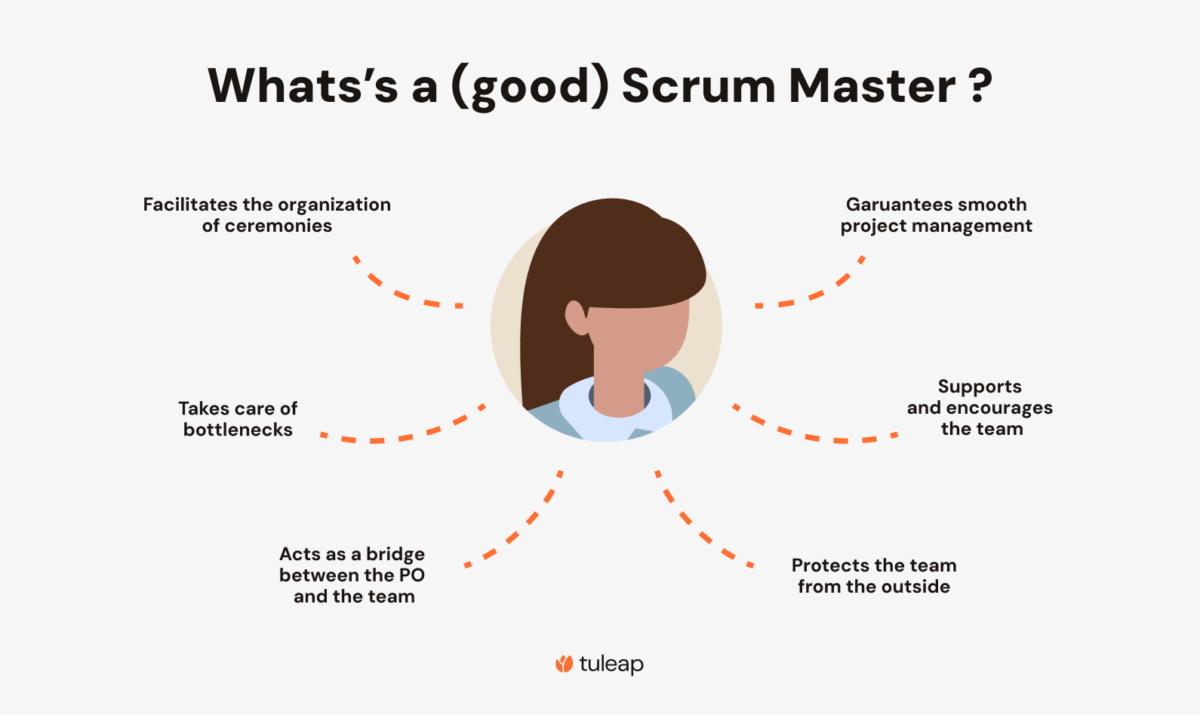
In other words, a Scrum Master is a team leader; they can be described as the guarantor of projects’ successful execution. But watch out! Before getting into details, let’s clear up any confusion about what a Scrum Master is and what they are not.
A Scrum Master is not…
- A project manager
- A manager
- A mother
- The eldest developer
- Someone compelled to take up this role
- Superman or Ladybug
… but rather
- An enabler
- A watchful and attentive guarantor
- A passionate agilist who embodies agile values
- A member of the development team, willing to make it advance
- An actor of change looking for new ideas, tools and agile games/approaches to solve pain-points
It is fundamental to underline one more time that a Scrum Master is not a manager. Instead, they are an enabler, someone who smooths processes and interactions. Actually, according to the Scrum approach, the decision-making is up to the team since neither the Scrum Master nor the Product Owner are in charge of dispatching tasks among team members. In other words, the latter assign tasks to themselves depending on their preferences, skills and competences.
What Does a Scrum Master Do? Core Responsibilities
The daily work of a Scrum Master revolves around three core functions that support the team and the organization.
Facilitating Scrum Events
The Scrum Master ensures that all Scrum events are positive, productive, and kept within their time limits.
- Sprint Planning: They facilitate the meeting where the team plans the work for the upcoming Sprint, protecting them from over-committing.
- Daily Scrum: They ensure this short, 15-minute daily meeting happens, allowing the team to sync up and plan their day. The purpose is for the team to inspect and adapt its progress toward the Sprint Goal.
- Sprint Review: They help organize the session where the team demonstrates its completed work to stakeholders to gather valuable feedback.
- Sprint Retrospective: They lead this crucial meeting where the team reflects on its process and identifies concrete ways to improve in the next Sprint.
Removing Impediments
A primary function of the Scrum Master is to remove any blockers that hinder the team’s progress. These impediments can be technical (like a broken server), organizational (like a dependency on another team), or interpersonal. The Scrum Master acts as a problem-solver, clearing the path so the team can maintain focus and momentum.
Coaching and Mentoring
Perhaps the most important function is that of a coach and mentor.
- Coaching the Team: They guide the team in self-management and cross-functionality, helping them resolve conflicts and grow into a high-performing unit.
- Coaching the Product Owner: They offer techniques for effective Product Backlog management to maximize the value the team delivers.
- Coaching the Organization: They help stakeholders and other departments understand Scrum, enabling effective collaboration with the team.
Scrum Master vs. Project Manager
| Parameter | Scrum Master | Project Manager |
| Primary Goal | Foster a high-performing, self-managing team and ensure Scrum is effective. | Deliver a project on time, within budget, and according to scope. |
| Leadership Style | Servant-Leader: Coaches, facilitates, and empowers. | Directive Leader: Plans, directs, coordinates, and controls. |
| Focus | Process and People. “How” the team works. | Project and Logistics. “What” gets delivered and “when”. |
| Accountability | For the team’s effectiveness and adoption of Scrum (distributed accountability). | The single point of accountability for the project’s success or failure. |
| Team Interaction | An integral, daily member of the team; a coach from within. | Often manages from a step removed, coordinating between teams and stakeholders. |
How do I become a Scrum Master?
Since the human aspect is at the very heart of this role, it will be more suitable (and easier) for a « sociable » person who is familiar with the members of both the team and the whole organization. There is no need to attend a specific course or have an official certification to become a Scrum Master. It is not a profession, it’s a role. What matters is to master the subject, have a comprehensive understanding of the responsibilities and obviously embody the values of the Agile Manifesto.
As a transformation leader, a Scrum Master has to be a driving force, not afraid of changing organizational habits – smoothly, of course. What’s more to complete the « perfect profile » of a Scrum Master? Being able to find alternatives as well as being organized and rigorous to plan events.
Let’s not forget the most important quality to have: a collaborative spirit. A Scrum Master has to bring a community of people together in order to achieve a common goal, making sure everyone is involved and fostering collaborative dynamics.
It is also possible to have multiple Scrum Masters, for instance a two-people shift. Each one in turn, a developer takes up the role of Scrum Master when changing release, as to facilitate and lead the upcoming sprints. Opting to alternate between two Scrum Masters may turn out to be a useful solution to boost team dynamics, since each one of them will bring to the table their point of view, sensitivities and freshness. Moreover, this approach helps the current Scrum Master have more hindsight and hence better support the team.
Also, the Scrum Master plays a role in some others of the top 5 scaling agile methods.
What’s the Scrum Master’s daily routine?
Here’s some concrete examples of Scrum Master’s roles and responsibilities in an agile enterprise based on our own experience:
Sprints monitoring
The Scrum Master feeds back information to their teammates about the successful completion of the sprint or, otherwise, about the improvements needed. All this, thanks to previous analyses of Scrum charts, notably the Burnup and Burndown ones. As a consequence, the Scrum Master can also collaborate with the Product Owner to agree on future potential tasks.
Raising alerts
The development team chooses to limit the number of simultaneous code review to avoid overloading the workflow. When this set capacity is reached, the Scrum Master warns the dev team in order to solve the problem.
Reminding the team of their organization
Serving as a mirror of the team, the Scrum Master may also remind their teammates of their own decisions, the work rules they had defined together initially. For example: “We decided not to start new tasks if we are still working on 4 others. Be careful, we were about to make this mistake”.
Challenging certain decisions
The Scrum Master can help both the team and the Product Owner to accurately define important terms such as the Definition of Done and the Definition of Ready. For example, as it follows: “We had decided that our definition of done was… then, during our retrospectives, we realized that it didn’t really satisfy the whole team. So I suggest that we discuss it further again”.
Sharing agile values with everyone, including new hires
Each time a new developer joins the team, it is of paramount importance that they will be immediately immersed into the team culture, so the agile culture.
The easiest way to do so is to organize agile games (aka serious games). Actually, workshops such as LegoforScrum, Marshmallow challenge or even Scrum ball, turn out to be very useful for the whole team: on the one hand, they play as agile reminders for current developers; on the other hand, they facilitate agile values appropriation for new hires.
FAQ
Read on
Go further with Scrum and the Scrum Master role
Download the Scrum key takeaways kit →