

What is SAFe®?
SAFe® is an agile management method that emerged a little late compared to its counterparts. This methodology was actually developed and published by Dean Leffingwell, a management consultant and software developer, in 2011. According to the author himself, SAFe® can be defined as a business framework,
“A body of knowledge integrating skill sets, practices and values that have proven their worth and efficiency, making it possible to scale Agile across the enterprise through Lean, Agile and DevOps approaches.”
In other words, SAFe® belongs to the Agile family, such as Scrum and Kanban.
The only and major difference is that its framework is not restricted to a team’s functioning only, SAFe® is meant to be part of the whole business strategy. It considers agility as a company-wide, cross-functional process: that’s why we talk about Agile at Enterprise Scale.
In that sense, Enterprise Agile Planning (EAP) tools can help support this framework and agile methods.
Why should you use SAFe®?
Companies generally turn to SAFe® when they need to reinforce alignment across business strategy, improve flexibility inside each agile team, or bring more coherence to how everyone collaborates.
But let’s be clear: SAFe® is not for every organization. It only truly makes sense when you’re dealing with multiple agile development teams, usually several dozens or even hundreds of people.
SAFe® vs Scrum: what’s the difference?
SAFe® and Scrum are among the most popular agile project management methods.
However, SAFe® was conceived to overcome the limitations of Scrum when you need agility at enterprise scale.
The goal? A real organizational transformation by applying agile values across all departments, not just the development teams.
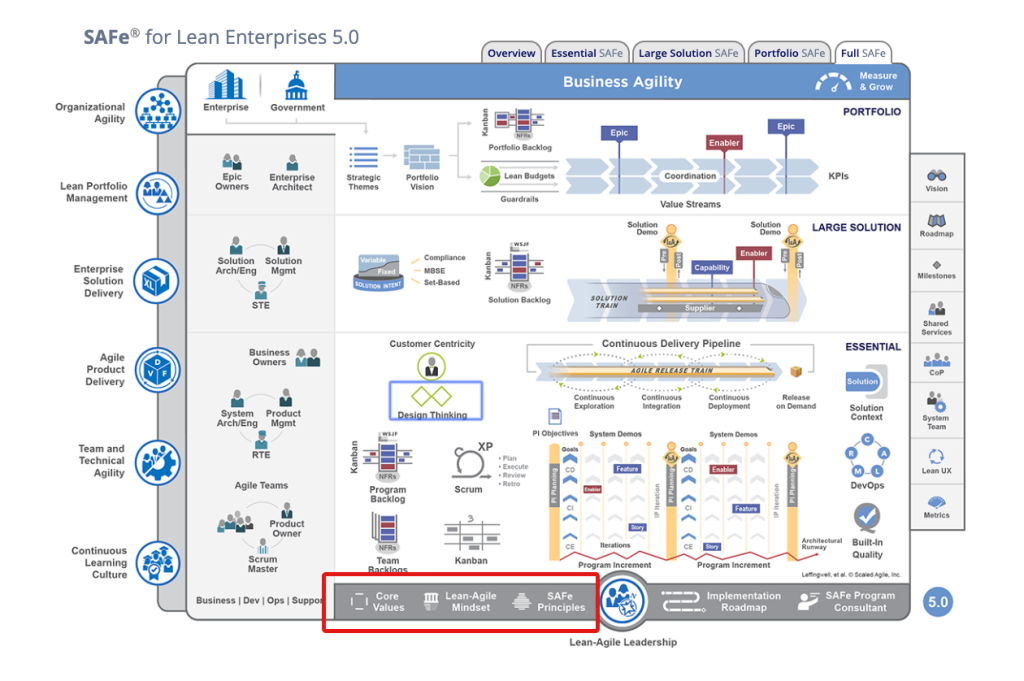
The pillars of SAFe® 5.0
1 mindset
“Lean-Agile” mindset is the psychological foundation needed to integrate SAFe® into an organization.
- Lean and Agile
- Systems thinking
- DevOps
5 values
SAFe® relies on 5 core values:
- Alignment
- Quality
- Transparency
- Program execution
- Direction
10 principles
- #1 Adopt an economic view
- #2 Apply systems thinking
- #3 Take variability into account
- #4 Build incrementally
- #5 Set milestones
- #6 Visualize and limit WIP
- #7 Define cadence
- #8 Encourage intrinsic motivation
- #9 Decentralize decision-making
- #10 Put value at the heart of strategy
An agile method based on a three-level structure
SAFe® 4.6 used to include 4 levels; since SAFe® 5.0, the framework has been simplified into 3 levels.
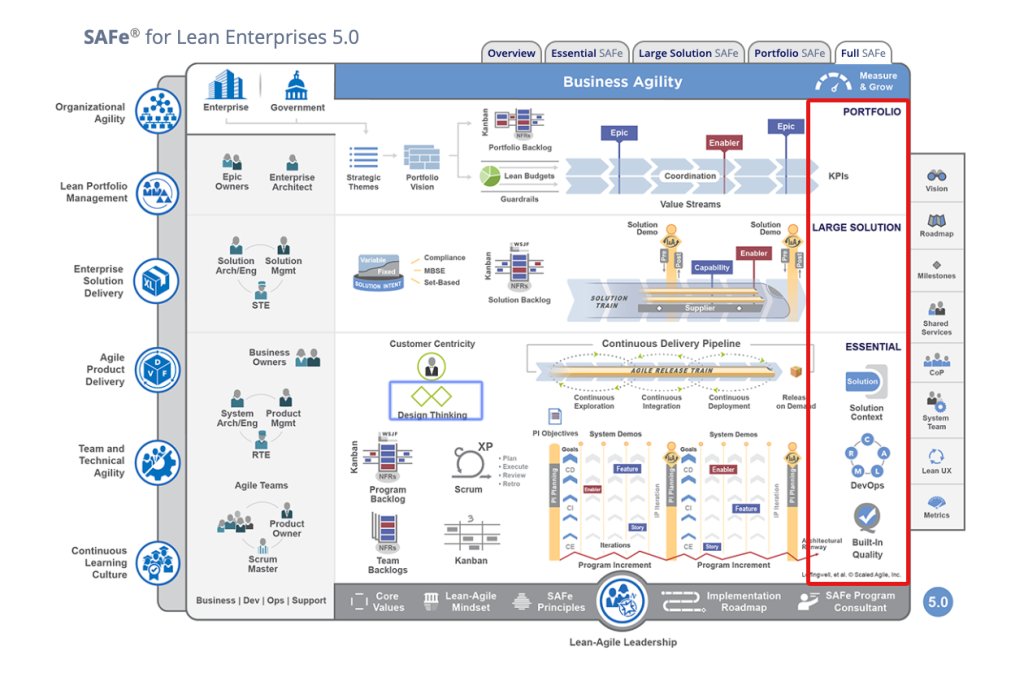
Portfolio
This level corresponds to agility implemented at top-management level.
Large
This level introduces additional roles, events and artifacts for large organizations.
Essential
This is the core level, gathering the key roles, events and artifacts needed to continuously deliver business solutions.
Agile at scale: more than just SAFe®
However, although SAFe provides strong guidelines for business reorganization, shifting the corporate culture and adopting new values is the most important part of the transformation.
Implementing SAFe® is more complex than other agile methods. Before getting started, take the time to analyze your needs and define why you want agility at scale.
And yes, it is possible to scale agile without SAFe®. Other frameworks exist: LeSS, Nexus, Scrum@Scale…
At the end of the day, SAFe® has its downsides too: its complexity and multiple roles may take you away from agility’s main purpose.