Tuleap is a comprehensive, sovereign ALM platform that centralizes the entire software development lifecycle within a single solution:
Deployable on-premises, Tuleap enables organizations to reduce complexity, regain control of their data, and unify their development processes.
Tuleap supports the entire Software Development Lifecycle (SDLC) by bringing together Agile, DevOps, Requirements Management, and Quality Management practices within a single platform.
Discover how Tuleap helps teams plan, track, develop, test, and deliver better products
Discover Tuleap →
What is ALM?
ALM stands for Application Lifecycle Management.
An ALM platform centralizes all activities involved in software development within a single environment:
- Requirements Management
- Agile Project Management
- Source Code Management
- Continuous Integration and Continuous Deployment (CI/CD)
- Test Management
- Quality Assurance
- Requirements Traceability
The purpose of an ALM solution is to provide complete visibility across the software lifecycle and ensure consistency between business requirements, development activities, and delivered products.
Centralizing to Improve Governance: Why Organizations Are Looking to Consolidate Their Software Development Lifecycle
By 2026, digital sovereignty is no longer merely a strategic concern—it has become a top priority for organizations. In an environment where data is a critical asset and regulatory requirements continue to grow, maintaining control over software tools and infrastructure is no longer optional.
Yet, beyond sovereignty concerns, organizations face another major challenge: tool sprawl. Project management, requirements tracking, development, testing, documentation—teams often rely on a collection of disconnected solutions. These fragmented toolchains increase complexity and create operational silos.
The result is reduced visibility, weaker governance, and growing difficulties in ensuring software quality and compliance.
Software lifecycle management must be approached as an integrated, end-to-end process—not as a collection of isolated tools.
This raises an important question: How can organizations adopt a solution that is both comprehensive, secure, and fully under their control?
What if a single platform could manage your entire software development lifecycle while ensuring complete digital sovereignty?
A Fragmented Software Lifecycle: The Real-World Impact
In most organizations, software development still relies on a collection of specialized tools that are rarely unified:
- A ticketing system for managing requests and issues
- Git for source code management
- Separate CI/CD pipelines
- Testing and quality management tools
- Documentation and time-tracking solutions
- Dedicated requirements management tools
Each solution performs its specific role effectively. However, they often evolve independently, without a unified view of the overall development lifecycle.
What This Means in Practice
Most organizations continue to operate with a fragmented toolchain:
- A ticketing system for request management
- Git repositories for source code
- Independent CI/CD pipelines
- Testing and quality assurance tools
- Documentation and time-tracking solutions
- Separate requirements management systems
While each tool is efficient on its own, the lack of integration creates significant challenges:
- Limited visibility across the product lifecycle
- Constant context switching between tools
- Multiple integrations that must be maintained
- Increased risk of inconsistencies between lifecycle stages
- Significant operational overhead for DevOps and IT teams
This fragmentation is further compounded by challenges that are often underestimated:
- Growing dependence on external cloud services
- Increasing number of software vendors
- Difficulty maintaining full control over data
- Rising security and compliance requirements
Over time, teams find themselves managing not only software development but also an entire ecosystem of tools that must be maintained, integrated, and synchronized on a daily basis.
The real challenge is no longer selecting the best individual tools. It is adopting an ALM platform capable of unifying them into a coherent, traceable, and fully controlled software development lifecycle.
Tuleap: The Complete Sovereign ALM Platform
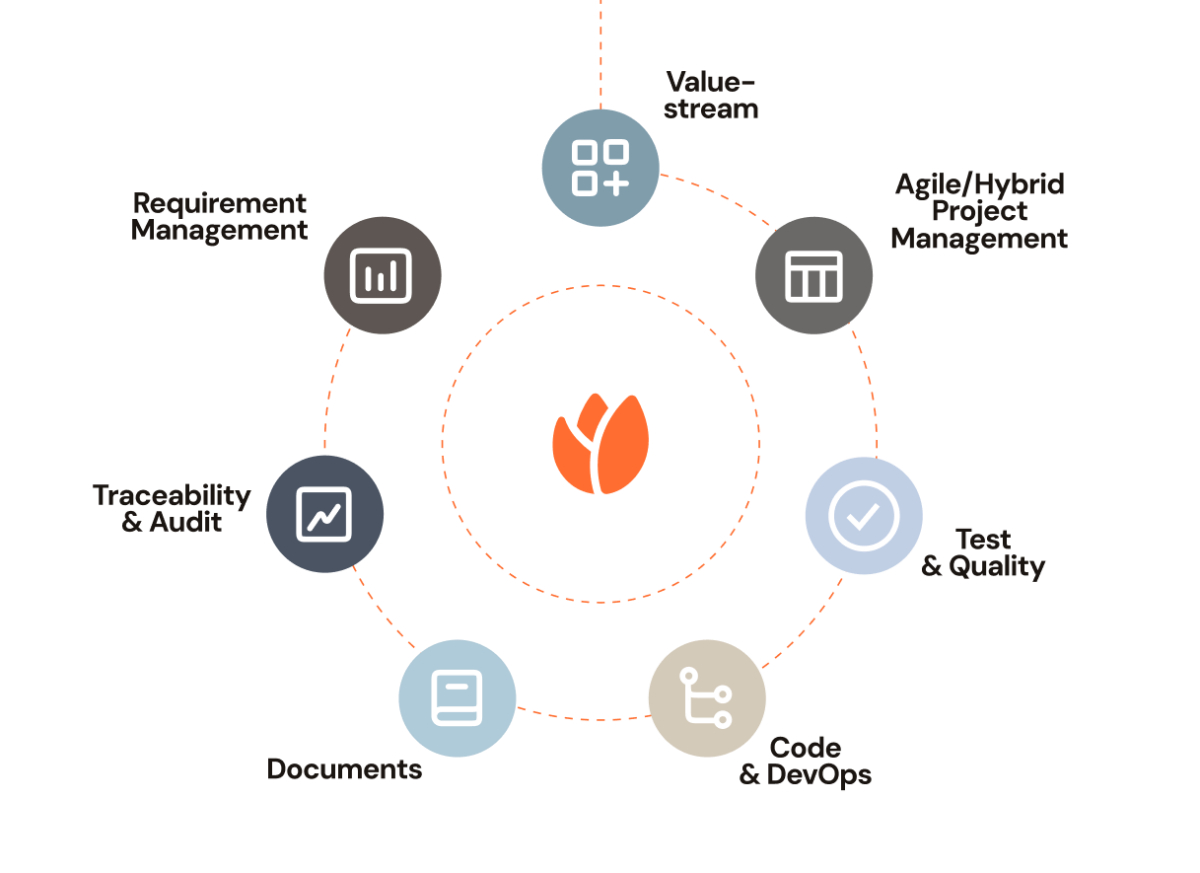
While solutions such as Jira often require third-party plugins to cover requirements management and end-to-end traceability, and cloud-based platforms such as Azure DevOps involve external dependencies for data hosting and control, Tuleap natively centralizes the entire software lifecycle within a sovereign, on-premises deployable environment.
End-to-End Software Lifecycle Management
Tuleap brings together every key stage of the software development lifecycle within a single platform:
- Requirements and business needs management
- Agile project management (Scrum and Kanban)
- Source code management with Git and code reviews
- Integration with CI/CD pipelines
- Test management and software quality assurance
- Full traceability between requirements, code, tests, and deliverables
Everything is connected natively within a single system.
A Sovereign Platform for Mission-Critical Industrial Projects
Tuleap addresses the growing need for control and ownership of software environments, particularly in industrial and regulated sectors subject to strict compliance requirements:
- On-premises deployment on the organization’s infrastructure
- Full ownership and control of data, without reliance on third-party hosting providers
- Support for European regulatory and compliance requirements
- Comprehensive audit trails to meet traceability and certification needs
Organizations retain full control over both their infrastructure and their data.
A Platform Designed for Teams
Beyond technology, Tuleap is designed to support users in their day-to-day work:
- Collaboration-focused user experience
- Suitable for both technical and business teams
- Extensive workflow customization capabilities
- Adapts to existing processes rather than forcing organizations to change them
The goal is not to impose a methodology, but to adapt to the way organizations already work.
Want to know more:
Request a demo →
They trust us
Discover how PCC improved project management efficiency and automation with Tuleap
FAQ
What is an ALM platform and why is it essential?
An ALM (Application Lifecycle Management) platform centralizes every stage of the software development lifecycle, from requirements management and development to testing, quality assurance, and delivery. It is essential because it replaces a collection of disconnected tools with a unified, traceable environment, reducing silos, inconsistencies, and operational overhead for development teams.
How does Tuleap differ from other software development platforms?
Tuleap stands out through three key strengths: comprehensive native ALM capabilities covering requirements management, Git, CI/CD, testing, and traceability; on-premises deployment that ensures full ownership of data; and compliance with European regulatory requirements. Unlike many cloud-based solutions, Tuleap gives organizations complete control over both their infrastructure and their data.
Why is digital sovereignty a key concern in 2026?
In 2026, digital sovereignty has become a critical decision-making factor for organizations, particularly in regulated industries and mission-critical projects. As reliance on foreign cloud providers increases and compliance requirements such as GDPR, NIS2, and sector-specific regulations continue to evolve, maintaining control over software tools and data is no longer a competitive advantage—it is a governance requirement.
Can Tuleap be deployed on-premises?
Yes. Tuleap is designed for on-premises deployment within an organization’s own infrastructure. This is one of its major advantages for regulated industries and organizations with strict data sovereignty requirements. No data needs to be hosted by a third-party provider, infrastructure remains fully under the control of internal IT teams, and deployments can be tailored to meet specific security and compliance constraints.
What is the difference between ALM and PLM?
ALM (Application Lifecycle Management) covers the lifecycle of software applications, including requirements management, development, testing, quality assurance, and deployment. PLM (Product Lifecycle Management), on the other hand, focuses on the lifecycle of a physical or industrial product, from design and manufacturing to end-of-life management.
The two disciplines often intersect in industries where physical products embed software, such as automotive, aerospace, medical devices, and industrial systems. However, they address different business needs and rely on distinct processes and tools.
Is Tuleap an alternative to Jira?
Yes, particularly for organizations looking for a unified and sovereign ALM platform. Jira is primarily a project tracking and issue management tool that typically relies on third-party products such as Xray, Zephyr, or Confluence to provide requirements management, traceability, testing, and documentation capabilities.
Tuleap integrates these capabilities natively within a single platform, eliminating dependency on external plugins while also offering on-premises deployment options that are not available with Jira Cloud.